Building strong muscles, maintaining good muscle mass and supporting effective recovery do not depend solely on increasing protein intake. Rather, several factors work together. The main factors are:
1. Resistance Training
Muscles need sufficient stimulation to adapt and become stronger, such as:
- Weight training
- Squats and lunges
- Push-ups
- Leg presses or resistance bands
- Increasing the training load gradually (progressive overload)
2. Adequate Protein and Amino Acids
Protein provides the building blocks needed for muscle repair and growth, particularly essential amino acids and leucine. Sources of protein include:
- Eggs
- Fish
- Lean meat
- Milk, nuts and tofu
- Whey or soy protein
3. Adequate Energy and Nutrients
If energy intake is too low, the body will find it difficult to build muscle. Adequate amounts of carbohydrates and healthy fats are also needed to support exercise performance and hormonal function.
4. Vitamins and Minerals, Particularly
- Vitamin D
- Vitamin B12
- Folate (Vitamin B9)
- Magnesium
- Zinc
- Iron
These nutrients are involved in muscle function, energy production, oxygen transport and recovery.
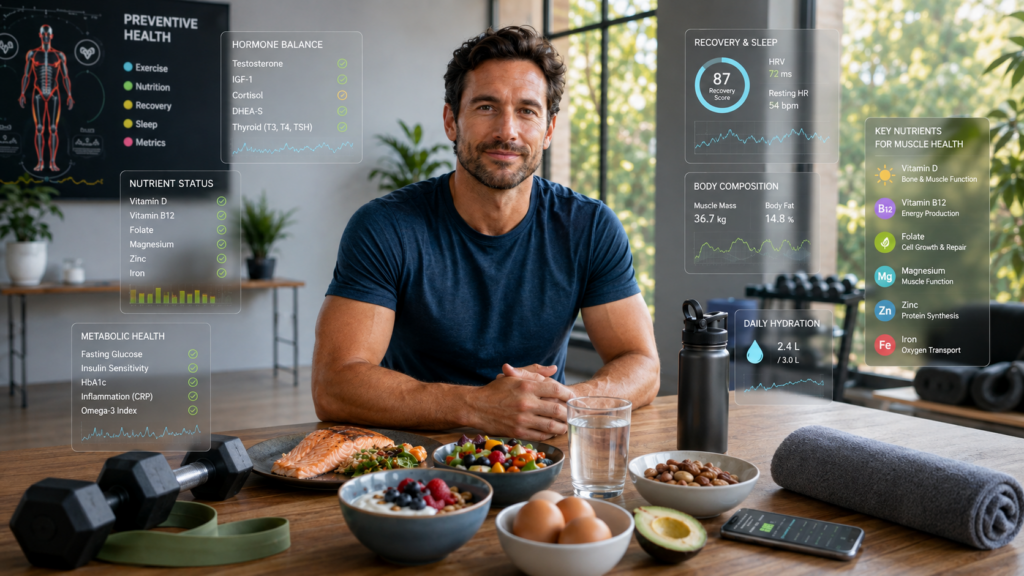
5. Hormonal Balance
- Testosterone
- IGF-1
- Growth Hormone
- DHEA-S
- Cortisol
- Thyroid hormones(FT3,FT4,TSH)
If hormones involved in muscle building and muscle breakdown become imbalanced, gaining muscle may become more difficult.
6. Sleep and Recovery
Good-quality, deep sleep is an important period during which the body repairs and recovers. It is recommended to get approximately 7–9 hours of sleep per night.
You should also avoid training the same muscle group intensely on consecutive days without allowing sufficient time for recovery.
7. Overall Health and Metabolism
Blood sugar and insulin levels, thyroid function, liver and kidney function, inflammation, and gut health can all affect how the body uses nutrients and builds muscle.
Summary
Strong muscles = Training + Protein + Nutrition + Hormonal Balance + Recovery + Good Metabolic Health
With a biomarker-based approach to muscle building, the following can be assessed:
- CBC
- Blood sugar
- HbA1c
- Kidney function
- Liver function
- Total Protein/Albumin (Ratio)
- Vitamin D
- Vitamin B12
- Folate (Vitamin B9)
- Iron study
- Magnesium
- Zinc
- FreeTestosterone (SHBG)
- DHEA-S
- IGF-1
- Cortisol
- Thyroid profile (FT3, FT4, TSH)
References
- American College of Sports Medicine. (2009). Progression models in resistance training for healthy adults. Medicine & Science in Sports & Exercise, 41(3), 687–708.
- Ceglia, L. (2008). Vitamin D and skeletal muscle tissue and function. Molecular Aspects of Medicine, 29(6), 407–414.
- Cruz-Jentoft, A. J., Bahat, G., Bauer, J., Boirie, Y., Bruyère, O., Cederholm, T., Cooper, C., Landi, F., Rolland, Y., Sayer, A. A., Schneider, S. M., Sieber, C. C., Topinkova, E., Vandewoude, M., Visser, M., & Zamboni, M. (2019). Sarcopenia: Revised European consensus on definition and diagnosis. Age and Ageing, 48(1), 16–31.
- Dattilo, M., Antunes, H. K. M., Medeiros, A., Mônico Neto, M., Souza, H. S., Tufik, S., & de Mello, M. T. (2011). Sleep and muscle recovery: Endocrinological and molecular basis for a new and promising hypothesis. Medical Hypotheses, 77(2), 220–222.
- Kraemer, W. J., & Ratamess, N. A. (2005). Hormonal responses and adaptations to resistance exercise and training. Sports Medicine, 35(4), 339–361.
- Morton, R. W., Murphy, K. T., McKellar, S. R., Schoenfeld, B. J., Henselmans, M., Helms, E., Aragon, A. A., Devries, M. C., Banfield, L., Krieger, J. W., & Phillips, S. M. (2018). A systematic review, meta-analysis and meta-regression of the effect of protein supplementation on resistance training-induced gains in muscle mass and strength in healthy adults. British Journal of Sports Medicine, 52(6), 376–384.
- Phillips, S. M., & Van Loon, L. J. C. (2011). Dietary protein for athletes: From requirements to optimum adaptation. Journal of Sports Sciences, 29(Suppl. 1), S29–S38.
- Wolfe, R. R. (2017). Branched-chain amino acids and muscle protein synthesis in humans: Myth or reality? Journal of the International Society of Sports Nutrition, 14, Article 30.