

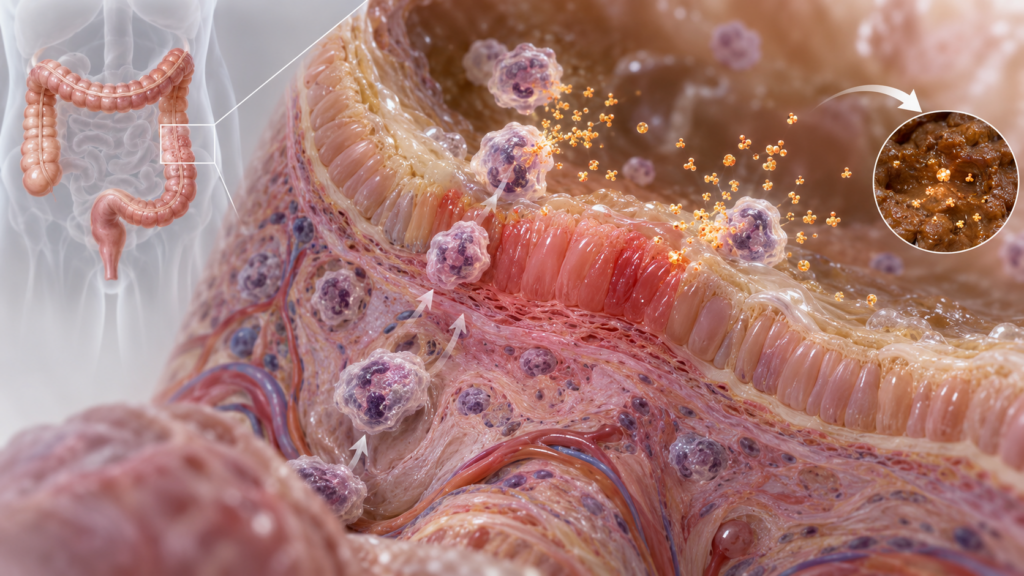
Calprotectin is a protein found in high concentrations in a type of white blood cell called a neutrophil. Its levels increase when the intestinal lining becomes inflamed.
Faecal Calprotectin is a test that measures the level of calprotectin protein in stool. It is a stool-based marker of intestinal inflammation, derived mainly from neutrophils. When the intestinal lining becomes inflamed (intestinal mucosal inflammation), white blood cells migrate to the affected area, resulting in increased levels of calprotectin in the stool.
Why Is Faecal Calprotectin Important?
Faecal Calprotectin is a biomarker of intestinal inflammation that does not require either an endoscopic examination or a blood test. It can therefore be useful in helping to distinguish whether gastrointestinal symptoms are more likely to be caused by genuine inflammation or by a functional disorder of the bowel.
It is particularly useful in supporting the assessment of Inflammatory Bowel Disease (IBD), such as Crohn’s disease and ulcerative colitis, and can also help monitor the level of inflammation and response to treatment.
By contrast, people with Irritable Bowel Syndrome (IBS), which is a functional gastrointestinal disorder, may experience symptoms such as abdominal pain, bloating, constipation, diarrhoea or changes in bowel habits, but generally do not have the same type of intestinal inflammation seen in IBD.
Therefore, Faecal Calprotectin does not directly diagnose IBS. Rather, it helps determine whether there is evidence of intestinal inflammation.
- High Faecal Calprotectin: May indicate intestinal inflammation, such as that associated with IBD (Crohn’s disease or ulcerative colitis), or an intestinal infection.
- Normal/low Faecal Calprotectin: In someone experiencing abdominal pain, bloating, diarrhoea or constipation, a normal or low result may support the possibility of IBS rather than IBD. However, the result should still be interpreted alongside symptoms and other relevant factors.
IBD: Intestinal inflammation is present, and Calprotectin levels are often elevated.
IBS: There is no clear evidence of intestinal inflammation, and Calprotectin levels are generally not elevated.
Principles of Interpretation
A high Faecal Calprotectin level is a signal that further investigation may be needed to identify the underlying cause of intestinal inflammation.
However, an elevated result does not by itself diagnose IBD. Calprotectin can also be elevated due to gastrointestinal infections, certain medications and other conditions. Results should therefore be interpreted together with the person’s symptoms, medical history and other investigations.
Summary
The key point is that Faecal Calprotectin is not specific to IBD. Instead, it helps indicate whether intestinal inflammation is present and can be useful in distinguishing conditions involving inflammation, such as IBD, from functional disorders such as IBS.
References
- Bamias, G., Fessatou, S., Kapizioni, C., Kitsou, K., Kokkotis, G., Kourti, A., Markopoulos, P., Orfanoudaki, E., Siakavellas, S., & Tzouvala, M. (2026). Expert recommendations regarding the use of fecal calprotectin in daily clinical practice: Statements of a taskforce process from the Hellenic Group for the Study of Inflammatory Bowel Disease (EOMIFNE). Annals of Gastroenterology, 39(2), 161–173.
- D’Amico, F., Rubin, D. T., Kotze, P. G., Magro, F., Siegmund, B., Kobayashi, T., Olivera, P. A., Bossuyt, P., Pouillon, L., Louis, E., Domènech, E., Ghosh, S., Danese, S., & Peyrin-Biroulet, L. (2021). International consensus on methodological issues in standardization of fecal calprotectin measurement in inflammatory bowel diseases. United European Gastroenterology Journal, 9(4), 451–460.
- Manceau, H., Chicha-Cattoir, V., Puy, H., & Peoc’h, K. (2017). Fecal calprotectin in inflammatory bowel diseases: Update and perspectives. Clinical Chemistry and Laboratory Medicine, 55(4), 474–483.