Gut Dysfunction refers to abnormal or impaired function of the gastrointestinal tract and intestines. It is not a specific disease in itself, but rather an umbrella term covering a range of functional disturbances, from digestion and nutrient absorption to the intestinal lining, gut microbiome, immune function and intestinal motility.
What Does a Gut Health Programme Assess?
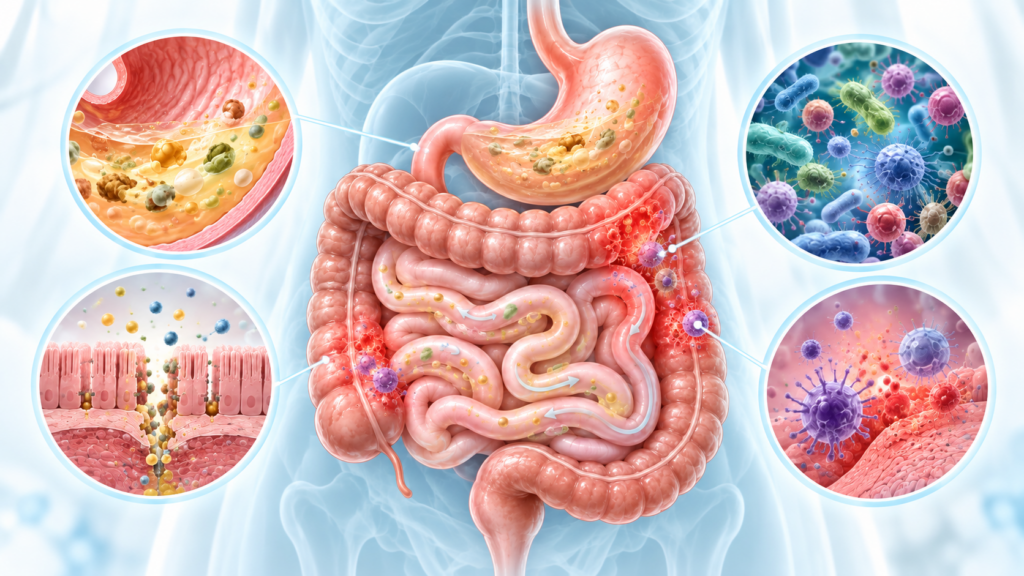
A comprehensive assessment of Gut Health consists of five main components:
1. Gut Barrier Dysfunction
Gut Barrier Dysfunction refers to abnormalities in the intestinal barrier, including increased intestinal permeability, commonly referred to as “leaky gut”. This may affect the normal regulation of substances passing through the intestinal lining.
2. Gut Dysbiosis / Microbiome Imbalance
Gut Dysbiosis refers to an imbalance in the composition, diversity or function of microorganisms in the gut, including bacteria, fungi and viruses, as well as their collective genetic material, known as the microbiome.
Changes in the gut microbiome may be associated with inflammation and alterations in gut barrier function.
3. Gut Inflammation / Immune Dysfunction
This refers to abnormal inflammation or immune responses within the gastrointestinal tract. It may occur in a number of conditions, including:
- Inflammatory Bowel Disease (IBD), such as Crohn’s disease and ulcerative colitis
- Coeliac disease — an immune-mediated condition triggered by gluten that can damage the lining of the small intestine and affect nutrient absorption
- Gastrointestinal infections
4. Digestion & Absorption Dysfunction
This refers to impaired digestion or absorption of nutrients, which may occur in conditions such as:
- Pancreatic exocrine insufficiency — inadequate production or delivery of digestive enzymes by the pancreas
- Coeliac disease
- Malabsorption, which may contribute to deficiencies in iron, vitamin B12, folate, vitamin D and other nutrients
5. Gut Motility Dysfunction
Gut Motility Dysfunction refers to abnormal movement of food and digestive contents through the gastrointestinal tract. It may contribute to constipation, diarrhoea, bloating or certain functional gastrointestinal disorders (FGIDs).
Summary: The Five Main Components of Gut Health
- Gut Barrier
- Gut Microbiome
- Inflammation & Immunity
- Digestion & Absorption
- Gut Motility
Functional Domains of Gut Health
| Functional Domain | Biomarkers / Tests | What Is Assessed? |
|---|---|---|
| 1. Gut Barrier | Zonulin* | Intestinal permeability / gut barrier integrity |
| 2. Dysbiosis / Microbiome | Stool microbiome analysis* | Composition and diversity of the gut microbiome |
| Stool pathogen panel (where clinically indicated) | Detection of gastrointestinal pathogens | |
| 3. Inflammation & Immunity | Faecal Calprotectin ⭐ | Intestinal inflammation |
| hs-CRP / CRP | Systemic inflammation | |
| CBC | Anaemia, infection and other inflammatory clues | |
| 4. Digestion & Absorption | Faecal Elastase-1 | Exocrine pancreatic function |
| tTG-IgA + Total IgA | Coeliac disease screening | |
| Ferritin + Iron Studies | Iron status / possible malabsorption | |
| Vitamin B12 | Vitamin B12 status | |
| Folate | Folate status | |
| Vitamin D | Vitamin D status | |
| Albumin / Total Protein | Nutritional status | |
| 5. Gut Motility | Clinical assessment | There is no specific blood biomarker for gut motility; assessment is primarily based on symptoms and medical history, with additional testing where clinically indicated. |
Gut Health Program
The Gut Health Programme is divided into three levels:
- Basic Gut Health Screen
- CBC
- Albumin / Total Protein
- hs-CRP
- Ferritin / Iron Studies
- Vitamin B12
- Folate
- Vitamin D
- Comprehensive Gut Dysfunction
- CBC
- Albumin / Total Protein
- hs-CRP
- Ferritin / Iron Studies
- Vitamin B12
- Folate
- Vitamin D
- Faecal Calprotectin
- Faecal Elastase-1
- tTG-IgA + Total IgA
- Advanced Gut Function & Microbiome
- CBC
- Albumin / Total Protein
- hs-CRP
- Ferritin / Iron Studies
- Vitamin B12
- Folate
- Vitamin D
- Faecal Calprotectin
- Faecal Elastase-1
- tTG-IgA + Total IgA
- Stool microbiome analysis
- Pathogen testing (according to symptoms and clinical indications)
- Zonulin* (if required as part of an exploratory / functional assessment)
Decode Your Gut Through Biomarkers
From inflammation and digestion to absorption and microbial balance.
References
- Drossman, D. A. (2016). Functional gastrointestinal disorders: History, pathophysiology, clinical features, and Rome IV. Gastroenterology, 150(6), 1262-1279.
- Drossman, D. A., & Hasler, W. L. (2016). Rome IV—Functional GI disorders: Disorders of gut-brain interaction. Gastroenterology, 150(6), 1257–1261.
- Horowitz, A., Chanez-Paredes, S. D., Haest, X., & Turner, J. R. (2023). Paracellular permeability and tight junction regulation in gut health and disease. Nature Reviews Gastroenterology & Hepatology, 20, 417–432.
- Smalley, W., Falck-Ytter, C., Carrasco-Labra, A., Wani, S., Lytvyn, L., & Falck-Ytter, Y. (2019). AGA clinical practice guidelines on the laboratory evaluation of functional diarrhea and diarrhea-predominant irritable bowel syndrome in adults (IBS-D). Gastroenterology, 157(3), 851–854.